 Add to Chrome
 Add to Firefox
 Add to Edge
FrontierOR: Benchmarking LLMs' Capacity for Efficient Algorithm Design in Large-Scale Optimization
May 26, 2026
Large language models (LLMs) are increasingly used for optimization modeling and solver-code generation, yet practical operations research and optimization problems often require a harder capability: designing scalable algorithms that exploit problem structure and outperform direct formulation-and-solve baselines. Existing benchmarks are limited to small or simplified examples far below real-world scale and complexity. We introduce FrontierOR, among the first benchmarks to systematically evaluate LLM-based efficient algorithm design for realistic large-scale optimization problems. FrontierOR includes 180 tasks derived from methodologically diverse papers published in top-tier operations research venues, each with standardized instances and a hidden, expert-verified evaluation suite. We evaluate seven LLMs spanning frontier, cost-effective, and open-source models both in one-shot and test-time evolution settings. The results reveal that frontier models still struggle to move from executable formulations to efficient optimization algorithms: the strongest one-shot model outperforms Gurobi in only 31% of cases in both solution quality and computational efficiency, and even strong coding agents with test-time evolution achieve only 50% on selected hard tasks. FrontierOR establishes a practical evaluation platform for LLM-based optimization algorithm design, which enables future LLMs and agents to be systematically tested on whether they can move beyond correct formulation toward a feasible, high-quality, and efficient algorithm.

Scaling World-Model Reinforcement Learning Through Diffusion Policy Optimization
May 25, 2026Model-based reinforcement learning (RL) can be effectively supported at scale through the use of world models. However, in practice, scaling such approaches remains fundamentally limited. A commonly recognized challenge is model bias and error compounding, which degrade long-horizon predictions. Beyond these issues, we identify a more critical yet underexplored bottleneck: a structural misalignment between search and value learning in existing world model approaches. In particular, policy improvement often relies on value functions induced by a separate, non-search policy, resulting in training inconsistency and ultimately suboptimal learning. To address this limitation, we propose Model-Based Diffusion Policy Optimization (MBDPO) in world models, a framework that unifies search and policy optimization through diffusion policy representations, thereby unlocking the potential of world models for scalable policy learning. Instead of constructing an explicit planner over a learned world model, we reformulate policy optimization as a diffusion process over searched trajectories in latent world models. In this view, we extract an implicit energy function from the collected dataset that anchors the policy, enabling MBDPO to refine the score field for policy optimization while mitigating misalignment. We evaluate MBDPO across a wide range of settings, including multi-task offline pretraining, online learning, and offline-to-online fine-tuning. In the offline regime, we further investigate its scaling behavior by pretraining on large-scale datasets, observing consistent and monotonic performance gains with increasing model capacity.
Hy-MT2: A Family of Fast, Efficient and Powerful Multilingual Translation Models in the Wild
May 21, 2026Hy-MT2 is a family of fast-thinking multilingual translation models designed for complex real-world scenarios. It includes three model sizes: 1.8B, 7B, and 30B-A3B (MoE), all of which support translation among 33 languages and effectively follow translation instructions in multiple languages. For on-device deployment, with AngelSlim 1.25-bit extreme quantization, the 1.8B model requires only 440 MB of storage and improves inference speed by 1.5x. Multi-dimensional evaluations show that Hy-MT2 delivers outstanding performance across general, real-world business, domain-specific, and instruction-following translation tasks. The 7B and 30B models outperform open-source models such as DeepSeek-V4-Pro and Kimi K2.6 in fast-thinking mode, while the lightweight 1.8B model also surpasses mainstream commercial APIs from providers such as Microsoft and Doubao overall.
Probing CLIP's Comprehension of 360-Degree Textual and Visual Semantics
Apr 27, 2026The dream of instantly creating rich 360-degree panoramic worlds from text is rapidly becoming a reality, yet a crucial gap exists in our ability to reliably evaluate their semantic alignment. Contrastive Language-Image Pre-training (CLIP) models, standard AI evaluators, predominantly trained on perspective image-text pairs, face an open question regarding their understanding of the unique characteristics of 360-degree panoramic image-text pairs. This paper addresses this gap by first introducing two concepts: \emph{360-degree textual semantics}, semantic information conveyed by explicit format identifiers, and \emph{360-degree visual semantics}, invariant semantics under horizontal circular shifts. To probe CLIP's comprehension of these semantics, we then propose novel evaluation methodologies using keyword manipulation and horizontal circular shifts of varying magnitudes. Rigorous statistical analyses across popular CLIP configurations reveal that: (1) CLIP models effectively leverage explicit textual identifiers, demonstrating an understanding of 360-degree textual semantics; and (2) CLIP models fail to robustly preserve semantic alignment under horizontal circular shifts, indicating limited comprehension of 360-degree visual semantics. To address this limitation, we propose a LoRA-based fine-tuning framework that explicitly instills invariance to circular shifts. Our fine-tuned models exhibit improved comprehension of 360-degree visual semantics, though with a slight degradation in original semantic evaluation performance, highlighting a fundamental trade-off in adapting CLIP to 360-degree panoramic images. Code is available at https://github.com/littlewhitesea/360Semantics.
USCNet: Transformer-Based Multimodal Fusion with Segmentation Guidance for Urolithiasis Classification
Apr 08, 2026Kidney stone disease ranks among the most prevalent conditions in urology, and understanding the composition of these stones is essential for creating personalized treatment plans and preventing recurrence. Current methods for analyzing kidney stones depend on postoperative specimens, which prevents rapid classification before surgery. To overcome this limitation, we introduce a new approach called the Urinary Stone Segmentation and Classification Network (USCNet). This innovative method allows for precise preoperative classification of kidney stones by integrating Computed Tomography (CT) images with clinical data from Electronic Health Records (EHR). USCNet employs a Transformer-based multimodal fusion framework with CT-EHR attention and segmentation-guided attention modules for accurate classification. Moreover, a dynamic loss function is introduced to effectively balance the dual objectives of segmentation and classification. Experiments on an in-house kidney stone dataset show that USCNet demonstrates outstanding performance across all evaluation metrics, with its classification efficacy significantly surpassing existing mainstream methods. This study presents a promising solution for the precise preoperative classification of kidney stones, offering substantial clinical benefits. The source code has been made publicly available: https://github.com/ZhangSongqi0506/KidneyStone.
TRACE: Trajectory Recovery with State Propagation Diffusion for Urban Mobility
Mar 19, 2026High-quality GPS trajectories are essential for location-based web services and smart city applications, including navigation, ride-sharing and delivery. However, due to low sampling rates and limited infrastructure coverage during data collection, real-world trajectories are often sparse and feature unevenly distributed location points. Recovering these trajectories into dense and continuous forms is essential but challenging, given their complex and irregular spatio-temporal patterns. In this paper, we introduce a novel diffusion model for trajectory recovery named TRACE, which reconstruct dense and continuous trajectories from sparse and incomplete inputs. At the core of TRACE, we propose a State Propagation Diffusion Model (SPDM), which integrates a novel memory mechanism, so that during the denoising process, TRACE can retain and leverage intermediate results from previous steps to effectively reconstruct those hard-to-recover trajectory segments. Extensive experiments on multiple real-world datasets show that TRACE outperforms the state-of-the-art, offering $>$26\% accuracy improvement without significant inference overhead. Our work strengthens the foundation for mobile and web-connected location services, advancing the quality and fairness of data-driven urban applications. Code is available at: https://github.com/JinmingWang/TRACE
Diversity or Precision? A Deep Dive into Next Token Prediction
Dec 28, 2025Recent advancements have shown that reinforcement learning (RL) can substantially improve the reasoning abilities of large language models (LLMs). The effectiveness of such RL training, however, depends critically on the exploration space defined by the pre-trained model's token-output distribution. In this paper, we revisit the standard cross-entropy loss, interpreting it as a specific instance of policy gradient optimization applied within a single-step episode. To systematically study how the pre-trained distribution shapes the exploration potential for subsequent RL, we propose a generalized pre-training objective that adapts on-policy RL principles to supervised learning. By framing next-token prediction as a stochastic decision process, we introduce a reward-shaping strategy that explicitly balances diversity and precision. Our method employs a positive reward scaling factor to control probability concentration on ground-truth tokens and a rank-aware mechanism that treats high-ranking and low-ranking negative tokens asymmetrically. This allows us to reshape the pre-trained token-output distribution and investigate how to provide a more favorable exploration space for RL, ultimately enhancing end-to-end reasoning performance. Contrary to the intuition that higher distribution entropy facilitates effective exploration, we find that imposing a precision-oriented prior yields a superior exploration space for RL.
Hunyuan-TurboS: Advancing Large Language Models through Mamba-Transformer Synergy and Adaptive Chain-of-Thought
May 21, 2025As Large Language Models (LLMs) rapidly advance, we introduce Hunyuan-TurboS, a novel large hybrid Transformer-Mamba Mixture of Experts (MoE) model. It synergistically combines Mamba's long-sequence processing efficiency with Transformer's superior contextual understanding. Hunyuan-TurboS features an adaptive long-short chain-of-thought (CoT) mechanism, dynamically switching between rapid responses for simple queries and deep "thinking" modes for complex problems, optimizing computational resources. Architecturally, this 56B activated (560B total) parameter model employs 128 layers (Mamba2, Attention, FFN) with an innovative AMF/MF block pattern. Faster Mamba2 ensures linear complexity, Grouped-Query Attention minimizes KV cache, and FFNs use an MoE structure. Pre-trained on 16T high-quality tokens, it supports a 256K context length and is the first industry-deployed large-scale Mamba model. Our comprehensive post-training strategy enhances capabilities via Supervised Fine-Tuning (3M instructions), a novel Adaptive Long-short CoT Fusion method, Multi-round Deliberation Learning for iterative improvement, and a two-stage Large-scale Reinforcement Learning process targeting STEM and general instruction-following. Evaluations show strong performance: overall top 7 rank on LMSYS Chatbot Arena with a score of 1356, outperforming leading models like Gemini-2.0-Flash-001 (1352) and o4-mini-2025-04-16 (1345). TurboS also achieves an average of 77.9% across 23 automated benchmarks. Hunyuan-TurboS balances high performance and efficiency, offering substantial capabilities at lower inference costs than many reasoning models, establishing a new paradigm for efficient large-scale pre-trained models.
A Survey on Text-Driven 360-Degree Panorama Generation
Feb 20, 2025
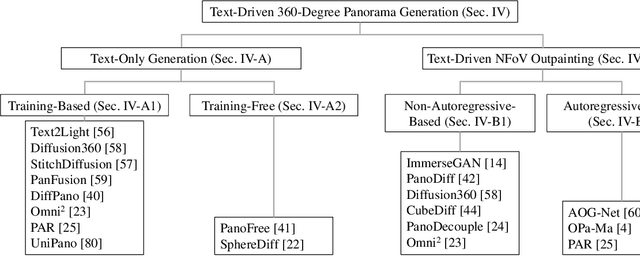
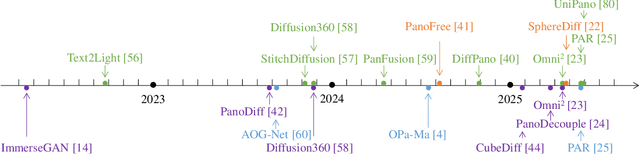
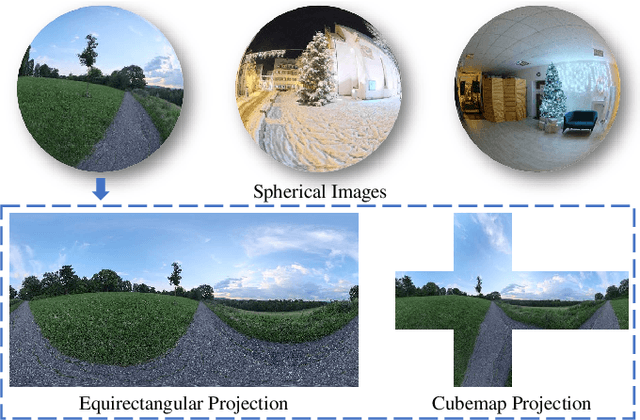
The advent of text-driven 360-degree panorama generation, enabling the synthesis of 360-degree panoramic images directly from textual descriptions, marks a transformative advancement in immersive visual content creation. This innovation significantly simplifies the traditionally complex process of producing such content. Recent progress in text-to-image diffusion models has accelerated the rapid development in this emerging field. This survey presents a comprehensive review of text-driven 360-degree panorama generation, offering an in-depth analysis of state-of-the-art algorithms and their expanding applications in 360-degree 3D scene generation. Furthermore, we critically examine current limitations and propose promising directions for future research. A curated project page with relevant resources and research papers is available at https://littlewhitesea.github.io/Text-Driven-Pano-Gen/.
Diffusion-Inspired Cold Start with Sufficient Prior in Computerized Adaptive Testing
Nov 19, 2024Computerized Adaptive Testing (CAT) aims to select the most appropriate questions based on the examinee's ability and is widely used in online education. However, existing CAT systems often lack initial understanding of the examinee's ability, requiring random probing questions. This can lead to poorly matched questions, extending the test duration and negatively impacting the examinee's mindset, a phenomenon referred to as the Cold Start with Insufficient Prior (CSIP) task. This issue occurs because CAT systems do not effectively utilize the abundant prior information about the examinee available from other courses on online platforms. These response records, due to the commonality of cognitive states across different knowledge domains, can provide valuable prior information for the target domain. However, no prior work has explored solutions for the CSIP task. In response to this gap, we propose Diffusion Cognitive States TransfeR Framework (DCSR), a novel domain transfer framework based on Diffusion Models (DMs) to address the CSIP task. Specifically, we construct a cognitive state transition bridge between domains, guided by the common cognitive states of examinees, encouraging the model to reconstruct the initial ability state in the target domain. To enrich the expressive power of the generated data, we analyze the causal relationships in the generation process from a causal perspective. Redundant and extraneous cognitive states can lead to limited transfer and negative transfer effects. Our DCSR can seamlessly apply the generated initial ability states in the target domain to existing question selection algorithms, thus improving the cold start performance of the CAT system. Extensive experiments conducted on five real-world datasets demonstrate that DCSR significantly outperforms existing baseline methods in addressing the CSIP task.